
Constitutional law, the bedrock of any nation’s governance, defines the fundamental principles and structures of power. It’s a fascinating blend of history, philosophy, and legal practice, shaping the relationship between the state and its citizens. Understanding constitutional law requires exploring its origins, key principles, and ongoing evolution, as it constantly adapts to societal changes and evolving interpretations.
This exploration delves into the core tenets of constitutional law, examining its sources, the mechanisms for checks and balances, and the crucial role it plays in safeguarding individual rights. We will investigate how different legal systems approach constitutional interpretation and the processes for amending these foundational documents. The journey will highlight landmark cases and illuminate the ongoing debate surrounding the balance between governmental authority and individual liberties.
Defining Constitutional Law
Constitutional law forms the bedrock of a nation’s legal system, outlining the fundamental principles governing the structure and operation of its government. It defines the relationship between the state and its citizens, establishing the rights and responsibilities of each. Understanding constitutional law is crucial for comprehending the framework within which a society functions and the mechanisms by which its laws are created and enforced.Constitutional law is essentially a body of rules and principles that define the structure and powers of government, and the relationship between the government and the people.
It sets out the basic framework for the governance of a country, including the distribution of powers among different branches of government, the protection of fundamental rights, and the mechanisms for amending the constitution. A simple way to think about it is that it’s the rulebook for how a country is run.
Fundamental Principles of Constitutional Law
Several key principles underpin constitutional law. These include the rule of law, which asserts that everyone, including the government, is subject to and accountable under the law; separation of powers, dividing governmental authority among distinct branches (typically legislative, executive, and judicial) to prevent tyranny; and checks and balances, a system where each branch of government can limit the power of the others.
Furthermore, constitutional law often emphasizes the protection of fundamental rights, guaranteeing citizens certain liberties such as freedom of speech, religion, and assembly.
Key Concepts in Constitutional Law
Separation of powers, as mentioned, is a cornerstone of many constitutional systems. This principle divides governmental power among legislative (lawmaking), executive (enforcement), and judicial (interpretation) branches. For example, in the United States, Congress makes laws, the President enforces them, and the Supreme Court interprets them. This division aims to prevent any one branch from becoming too powerful.Judicial review is another vital concept.
This is the power of the judiciary to review laws passed by the legislature and actions taken by the executive branch to determine their constitutionality. If a law or action is deemed unconstitutional, the court can strike it down. The landmark case ofMarbury v. Madison* (1803) established the principle of judicial review in the United States.
Historical Development of Constitutional Law: The United States
The development of US constitutional law is a rich and complex history. Initially, the Articles of Confederation, adopted in 1777, proved inadequate due to its weak central government. This led to the drafting and ratification of the United States Constitution in 1788, establishing a federal system with a stronger national government. The Constitution, with its Bill of Rights (the first ten amendments, guaranteeing fundamental rights), laid the foundation for the American legal system.
Subsequent amendments, Supreme Court decisions, and evolving societal norms have shaped and continue to shape the interpretation and application of constitutional principles. Landmark cases such asBrown v. Board of Education* (1954), which declared state laws establishing separate public schools for black and white students to be unconstitutional, profoundly impacted the course of American constitutional law. The ongoing debate and interpretation of the Constitution demonstrate its enduring relevance and its capacity to adapt to changing societal values and circumstances.
Key Constitutional Principles
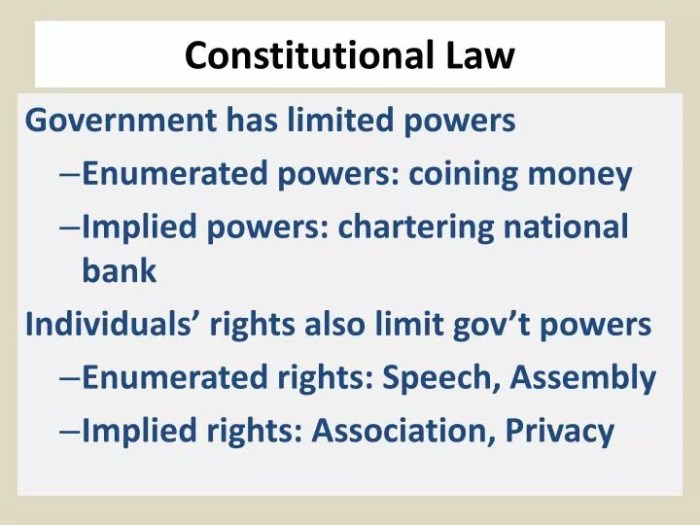
Constitutional law rests upon several fundamental principles that shape the structure and function of government and safeguard individual rights. These principles, while sometimes overlapping, provide the bedrock for a just and stable society. Understanding them is crucial to comprehending the essence of constitutionalism itself.
The Rule of Law
The rule of law is a cornerstone of any constitutional democracy. It dictates that everyone, including the government, is subject to and accountable under the law. This principle rejects arbitrary power and ensures that governmental actions are predictable, consistent, and justifiable according to established legal norms. It promotes fairness, equality before the law, and prevents the tyranny of the majority or unchecked executive power.
Examples of the rule of law in action include the ability of citizens to challenge government decisions in court, the independence of the judiciary, and the transparency of governmental processes. A robust system of checks and balances is essential to uphold the rule of law.
Fundamental Rights and Freedoms
Constitutions typically enshrine a bill of rights, outlining fundamental rights and freedoms that are inherent to individuals and cannot be arbitrarily infringed upon by the state. These rights often include freedoms of speech, religion, assembly, and the press, as well as protections against unreasonable searches and seizures, and the right to due process and a fair trial. The specific rights protected vary across different constitutional systems, but the overarching principle is the protection of individual autonomy and dignity.
The enforcement of these rights often involves judicial review, allowing courts to strike down laws that violate them. For example, the U.S. Bill of Rights, and the Canadian Charter of Rights and Freedoms, protect a range of fundamental rights and freedoms.
Models of Constitutionalism: Parliamentary Sovereignty vs. Judicial Review
Different constitutional systems adopt different models of constitutionalism, leading to varying relationships between the legislature, executive, and judiciary. Parliamentary sovereignty, prevalent in the United Kingdom, vests ultimate authority in the legislature. Parliament can, in theory, amend or repeal any law, including constitutional provisions. In contrast, systems with robust judicial review, such as the United States, grant courts the power to invalidate laws that are inconsistent with the constitution.
This power of judicial review acts as a check on legislative power, ensuring that laws conform to constitutional principles. The Canadian model provides a blend, with parliamentary supremacy but a strong role for judicial review, particularly concerning Charter rights. These differing models reflect different historical and political contexts and priorities.
Interaction Between Branches of Government
A constitutional framework typically establishes a separation of powers among the legislative, executive, and judicial branches. This separation is designed to prevent the concentration of power and to ensure checks and balances among the branches. The following flowchart illustrates a simplified model of this interaction:[Descriptive Flowchart]Imagine a flowchart with three boxes representing the Legislative, Executive, and Judicial branches.
Arrows connect them to show the interactions.* Legislative Branch (Makes Laws): This box shows arrows pointing to both the Executive (passing legislation, approving budgets) and the Judicial (creating laws, influencing judicial appointments).
Executive Branch (Implements Laws)
This box has arrows pointing to the Legislative (proposing legislation, implementing policies) and the Judicial (enforcing court orders, appointing judges).
Judicial Branch (Interprets Laws)
This box shows arrows pointing to both the Legislative (judicial review of laws) and the Executive (judicial review of executive actions).The arrows represent the checks and balances. For instance, the Judicial branch can review laws passed by the Legislative branch and actions taken by the Executive branch, ensuring they are constitutional. The Executive branch implements laws passed by the Legislative branch, and the Legislative branch can impeach and remove members of the Executive branch.
This cyclical relationship helps maintain balance and prevent any single branch from becoming too powerful.
Constitutional Law and the Structure of Government
Constitutional law not only defines fundamental rights but also meticulously Artikels the framework of government, establishing a system of checks and balances to prevent tyranny and ensure accountability. This framework typically divides governmental power among distinct branches, each with its own specific responsibilities and limitations. Understanding this division of power is crucial to grasping the essence of constitutional governance.
A fundamental principle underpinning many constitutional democracies is the separation of powers. This principle divides governmental authority among three distinct branches: the legislative, executive, and judicial. Each branch possesses unique powers and responsibilities, designed to prevent any single branch from accumulating excessive power and thereby threatening individual liberties. The interaction between these branches, particularly the mechanisms of checks and balances, is vital for maintaining a stable and just society.
Functions and Powers of Government Branches
The legislative, executive, and judicial branches each play a distinct role in the functioning of a government operating under a constitutional framework. The legislature creates laws, the executive enforces them, and the judiciary interprets them. This division, however, is not absolute; a system of checks and balances ensures that no single branch becomes overly dominant.
- Legislative Branch: This branch, typically a parliament or congress, is responsible for creating laws. Its powers include enacting statutes, levying taxes, declaring war, and ratifying treaties. The specific powers vary depending on the constitution.
- Executive Branch: This branch, usually headed by a president or prime minister, is responsible for enforcing laws passed by the legislature. Its powers include appointing officials, commanding the military, conducting foreign policy, and overseeing the administration of government programs.
- Judicial Branch: This branch, comprised of courts and judges, interprets laws and applies them to specific cases. Its powers include adjudicating disputes, reviewing the constitutionality of laws (judicial review), and ensuring that the government acts within its legal authority.
Checks and Balances
The system of checks and balances is a crucial mechanism to prevent the concentration of power in any single branch of government. It ensures that each branch can limit the power of the others, promoting accountability and preventing tyranny. This is achieved through a variety of mechanisms.
For instance, the legislature can impeach and remove executive and judicial officials. The executive branch can veto legislation passed by the legislature, and the judiciary can declare laws passed by the legislature or actions taken by the executive branch unconstitutional. This interplay of powers ensures that no single branch can act unilaterally without facing potential oversight or opposition from the others.
Constitutional Limits on Government Power
Constitutional law serves as a fundamental constraint on the power of government. It establishes limits on what the government can and cannot do, protecting individual rights and freedoms. These limits are often enshrined in a bill of rights or similar provisions within the constitution itself.
For example, a constitution might guarantee freedom of speech, religion, and assembly, while simultaneously placing limits on government surveillance and the power of law enforcement. The judiciary plays a crucial role in upholding these constitutional limits through judicial review, ensuring that government actions remain consistent with the supreme law of the land. Judicial review empowers the courts to strike down laws or government actions that are deemed unconstitutional, thus safeguarding individual rights and liberties from governmental overreach.
Key Responsibilities of Each Branch
The following Artikels the key responsibilities of each branch of government, illustrating the division of power and the intricate system of checks and balances inherent in a constitutional system.
- Legislative Branch: Lawmaking; budgetary control; oversight of the executive branch; declaration of war; ratification of treaties.
- Executive Branch: Enforcement of laws; appointment of officials; conduct of foreign policy; command of the military; administration of government programs.
- Judicial Branch: Interpretation of laws; adjudication of disputes; judicial review; ensuring adherence to the constitution.
In conclusion, constitutional law is far more than a static set of rules; it is a dynamic and evolving framework that shapes the very fabric of a society. From its historical roots to its ongoing interpretation, constitutional law continues to be a subject of intense scrutiny and debate, reflecting the enduring tension between individual rights and the power of the state.
Understanding its complexities is crucial for informed citizenship and effective participation in democratic processes.
Popular Questions
What is the difference between a constitution and a statute?
A constitution is a foundational document outlining the fundamental principles and structure of a government, while statutes are laws passed by a legislature within the framework of the constitution.
Can constitutional rights be limited?
Yes, most constitutions allow for limitations on rights under specific circumstances, often to protect public safety or the rights of others. These limitations are typically subject to judicial review.
What happens if a law conflicts with the constitution?
In most systems with judicial review, a court can declare a law unconstitutional and void it, rendering it unenforceable.
Who interprets the constitution?
Primarily, the judiciary interprets the constitution, although other branches of government also play a role in its application and enforcement.


