
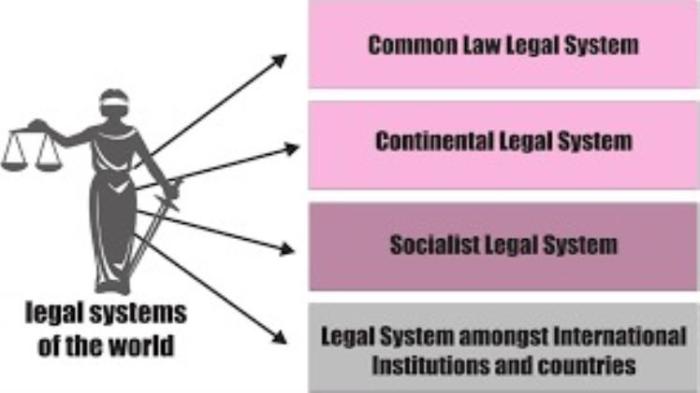
The world’s legal landscapes are as diverse as its cultures. From the ancient traditions of customary law to the codified structures of civil law, and the precedent-based systems of common law, understanding these variations is crucial for navigating international relations, business dealings, and even everyday life. This exploration delves into the fascinating intricacies of different legal systems, examining their origins, principles, and practical applications.
We will examine the key distinctions between common law, civil law, religious law, and mixed legal systems, highlighting the sources of law, judicial roles, and the unique approaches to legal reasoning within each. We will also touch upon the challenges of integrating customary law into modern frameworks and the complexities of international legal issues such as intellectual property and environmental law.
Common Law Systems
Common law systems, prevalent in many English-speaking countries and former British colonies, represent a distinct approach to legal reasoning and the development of law. Unlike systems based on codified statutes, common law relies heavily on judicial precedent, creating a dynamic and evolving legal landscape shaped by court decisions over time. This system offers both advantages and disadvantages, influencing legal practice and societal norms in significant ways.
Common law systems are characterized by several key features. Firstly, they emphasize the importance of judicial precedent, also known as
-stare decisis*, meaning “to stand by things decided.” This principle dictates that lower courts must follow the decisions of higher courts within the same jurisdiction when faced with similar cases. Secondly, these systems place significant weight on case law, which is the body of legal principles derived from judicial rulings.
Legislation, while important, often interacts with and is interpreted through the lens of existing case law. Finally, common law systems typically feature a more adversarial judicial process, where opposing parties present their arguments before a judge or jury who acts as an impartial arbiter.
The Role of Precedent and Judicial Decisions
The cornerstone of common law is the doctrine of
- stare decisis*. Judicial decisions, therefore, become binding authorities for future cases with similar facts and legal issues. Higher courts set precedents that lower courts must follow, ensuring consistency and predictability within the legal system. However, this isn’t a rigid system. Courts can distinguish cases based on material differences in facts, or even overturn previous precedents if deemed necessary, particularly by higher appellate courts.
This allows for the evolution of the law to adapt to changing social norms and circumstances. For example, the landmark U.S. Supreme Court case
- Brown v. Board of Education* (1954) overturned the precedent established in
- Plessy v. Ferguson* (1896) regarding racial segregation in public schools.
Comparison of Common Law and Other Legal Systems
Common law contrasts sharply with civil law systems, which are primarily based on comprehensive, codified statutes. In civil law systems, judges primarily apply the law as written in the codes, with less emphasis on precedent. In contrast, common law judges play a more active role in developing and interpreting the law through their decisions. Religious law systems, such as Islamic law (Sharia), derive their principles from religious texts and interpretations, offering a fundamentally different framework for legal reasoning and application.
Customary law systems, prevalent in some parts of the world, rely on long-established traditions and practices within specific communities, often existing alongside or integrated with other legal systems.
Comparison of Common Law and Civil Law Systems
| System Type | Sources of Law | Judicial Role | Legal Reasoning |
|---|---|---|---|
| Common Law | Judicial precedent (case law), legislation, custom | Develops and interprets law through decisions; acts as impartial arbiter | Inductive, based on precedent and analysis of specific facts |
| Civil Law | Comprehensive codified statutes, scholarly writings | Applies the law as written in the code; less involved in law creation | Deductive, based on application of general legal principles to specific facts |
Civil Law Systems
Civil law systems, in contrast to common law systems, are primarily based on codified statutes and legal codes. These comprehensive legal codes provide a structured framework for legal interpretation and application, aiming for a more predictable and consistent legal outcome. Unlike common law’s reliance on precedent, civil law emphasizes the systematic application of written law.
Core Principles of Civil Law Systems
The foundation of civil law systems rests on several key principles. Firstly, the principle of codified law dictates that all laws are systematically organized into comprehensive codes. Secondly, the principle of legal certainty emphasizes that laws are clearly written and accessible, minimizing ambiguity. Thirdly, the principle of inquisitorial procedure highlights that judges play an active role in investigating cases, rather than passively adjudicating between opposing parties, as is common in common law systems.
Finally, the principle of Roman law influence is evident in many civil law jurisdictions, as the Roman legal tradition profoundly shaped the development of these systems.
Primary Sources of Law in Civil Law Systems
The primary sources of law in civil law systems are codified statutes and legal codes. These codes are comprehensive collections of laws organized systematically, covering various aspects of the legal system, such as criminal law, civil law, and commercial law. Statutes passed by the legislature also hold significant weight, providing specific legal rules and regulations. While judicial precedent does exist, it holds less authority than the codified law itself.
In some civil law jurisdictions, scholarly legal writings, known as doctrine, also play a role in shaping legal interpretation.
The Role of Codified Law in Shaping Legal Decisions
Codified law serves as the cornerstone of legal decision-making in civil law systems. Judges are primarily tasked with interpreting and applying the existing codes and statutes to specific cases. The emphasis is on deductive reasoning, where judges derive the solution from the general principles laid out in the code, rather than relying heavily on previous judicial decisions. This approach aims to ensure consistency and predictability in legal outcomes across different cases.
The codes themselves often contain general principles, requiring judges to engage in some level of interpretation, but the focus remains on applying the codified law rather than creating new law through precedent.
Typical Process of a Civil Law Case
The following flowchart illustrates a simplified representation of the typical process in a civil law case:[Imagine a flowchart here. The flowchart would begin with “Filing of a Complaint,” followed by “Preliminary Investigation by Judge,” then “Evidence Gathering by Judge,” leading to “Trial (Judge as active investigator),” then “Judge’s Decision,” and finally, “Appeal (if applicable).”]The process begins with the filing of a complaint by a plaintiff.
The judge then conducts a preliminary investigation, actively gathering evidence through various means. This investigation forms the basis of the trial, where the judge acts as an active investigator, questioning witnesses and examining evidence. Finally, the judge renders a decision, which can be appealed to a higher court. This contrasts sharply with common law adversarial systems where the parties themselves bear the primary responsibility for presenting evidence and arguments.
Religious Law Systems

Religious law systems, also known as theocratic legal systems, derive their authority from religious texts and doctrines. Unlike secular systems, which are based on codified statutes and precedents, religious laws are interpreted and applied based on religious principles and beliefs. These systems often intertwine legal and religious authority, impacting various aspects of life, from personal conduct to governance.Religious law systems are diverse, reflecting the wide range of religious beliefs and practices globally.
Their application and interpretation can vary significantly depending on factors such as the specific religious text, the prevailing cultural context, and the level of interaction with secular legal frameworks.
Examples of Religious Legal Systems
Several legal systems are significantly influenced or directly based on religious texts and principles. Islamic law (Sharia), for instance, is derived from the Quran and the Sunnah (the teachings and practices of the Prophet Muhammad). Halakha, Jewish religious law, is derived from the Torah, Talmud, and other rabbinic writings. Canon law, the body of laws governing the Catholic Church, is based on biblical principles, papal pronouncements, and centuries of tradition.
Hindu law, though less codified than others, draws upon various scriptures and traditions, and its application varies regionally and across different sects. These examples illustrate the diversity and complexity of religious legal systems worldwide.
Application and Interpretation of Religious Law
The application and interpretation of religious law are often complex processes. In some cases, religious scholars or clerics play a crucial role in interpreting religious texts and applying them to specific legal situations. This can involve intricate processes of textual analysis, historical interpretation, and consideration of relevant religious precedents. The level of judicial independence and the extent to which religious authorities influence the legal process vary considerably across different religious legal systems.
In some contexts, religious courts exist alongside or in place of secular courts, leading to potential overlaps and conflicts.
Comparison of Religious and Secular Legal Systems
Religious and secular legal systems differ significantly in their sources of authority, enforcement mechanisms, and judicial processes. Secular systems primarily derive their authority from codified laws, constitutions, and judicial precedents. Enforcement relies on state-sponsored institutions, such as police and courts. Judicial processes are typically structured around adversarial proceedings, with judges playing a neutral role in interpreting and applying the law.
In contrast, religious legal systems derive their authority from religious texts and doctrines. Enforcement can involve religious authorities, community pressure, or state-backed institutions depending on the specific context. Judicial processes may be less formal and may involve religious scholars or clerics in interpreting and applying the law.
Key Differences Between Religious and Secular Legal Systems
The following points highlight the key differences between religious and secular legal systems:
- Sources of Law: Secular systems rely on codified laws, constitutions, and judicial precedents; religious systems derive authority from religious texts and doctrines.
- Enforcement Mechanisms: Secular systems employ state-sponsored institutions like police and courts; religious systems may involve religious authorities, community pressure, or state-backed institutions.
- Judicial Processes: Secular systems typically follow adversarial proceedings with neutral judges; religious systems may involve less formal processes with religious scholars or clerics participating in legal interpretation.
Mixed Legal Systems
Mixed legal systems are fascinating blends of different legal traditions, often reflecting a nation’s complex history and political landscape. These systems aren’t simply a haphazard mix; they represent a deliberate or evolutionary integration of legal principles, resulting in unique and often nuanced approaches to jurisprudence. Understanding these systems requires examining the historical context, the specific legal traditions involved, and the mechanisms used to resolve conflicts between potentially contradictory principles.Many countries operate under mixed legal systems, showcasing the diverse ways legal traditions can intertwine.
These systems are not static; they evolve over time, influenced by internal and external factors.
Countries with Mixed Legal Systems
Several countries exemplify the complexities of mixed legal systems. South Africa, for instance, combines elements of Roman-Dutch civil law, English common law, and customary law. Scotland similarly integrates elements of Roman law, common law, and its own unique historical legal traditions. Louisiana in the United States retains aspects of its French civil law heritage alongside the broader American common law system.
These examples highlight the diverse ways in which different legal traditions can coexist and interact within a single jurisdiction. The specific balance and interaction between these traditions vary considerably depending on the country’s unique history and political development.
Reconciling Conflicting Legal Principles in Mixed Systems
The inherent challenge in mixed systems lies in reconciling potentially conflicting principles from different legal traditions. This is often achieved through a variety of mechanisms. Judicial precedent plays a crucial role, with courts interpreting and applying the law in a way that seeks to harmonize competing principles. Legislation can also explicitly address conflicts, creating a framework for resolving disputes between different legal traditions.
Furthermore, the legal profession itself often plays a key mediating role, with lawyers and judges skilled in navigating the complexities of the mixed system. The process is often iterative, with the balance between different traditions shifting over time based on judicial decisions and legislative changes.
Historical and Political Factors Shaping Mixed Legal Systems
The historical and political context is paramount in understanding the development of mixed legal systems. Colonialism played a significant role in many cases, with the imposition of a foreign legal system (often common law) alongside pre-existing indigenous or civil law traditions. Post-colonial states often grapple with the legacy of these historical influences, seeking to balance the needs of modernization with the preservation of cultural identity and legal traditions.
Political changes, such as revolutions or independence movements, can also profoundly impact the structure and operation of a mixed legal system. The resulting system is a dynamic reflection of these historical and political forces, constantly adapting and evolving.
Interaction Between Legal Traditions: The Example of South Africa
South Africa provides a compelling case study of the interaction between different legal traditions within a mixed system. Its legal system is a complex blend of Roman-Dutch civil law (inherited from its Dutch colonial past), English common law (introduced during British rule), and indigenous customary law (representing the legal traditions of various African communities). The courts play a crucial role in balancing these traditions, often employing principles of judicial precedent to reconcile conflicting norms.
For example, in cases involving land ownership, the courts might consider both Roman-Dutch principles of property rights and customary law pertaining to communal land tenure. The resulting legal landscape is a testament to the intricate interplay between these different legal traditions, demonstrating the capacity of mixed systems to adapt and evolve in response to changing social and political circumstances.
Customary Law Systems
Customary law systems represent a significant portion of the world’s legal landscapes, particularly in many parts of Africa, Asia, and the Pacific. Unlike codified systems like civil or common law, customary law derives its authority from long-established traditions, social norms, and community practices. It’s often unwritten, passed down through generations orally, and deeply intertwined with the cultural and social fabric of the community.Customary law functions as a primary source of dispute resolution and social regulation within these communities.
It addresses a wide range of issues, from land ownership and inheritance to marriage, family matters, and even criminal offenses. Its strength lies in its close connection to the lived experiences and values of the people it governs.
The Role of Tradition and Community Consensus in Customary Law
Tradition forms the bedrock of customary law. Rules and principles are not created by a legislature or judiciary but emerge organically over time through repeated practice and acceptance within a community. This long-standing acceptance gives these rules legitimacy and authority. Community consensus plays a crucial role in the evolution and application of customary law. Decisions are often reached through discussions, negotiations, and mediation involving community elders, leaders, and other respected members.
This process ensures that the law remains relevant and responsive to the changing needs of the community while upholding its core principles. The constant dialogue and adaptation within the community demonstrate the dynamic nature of customary law, allowing it to remain functional across generations.
Challenges in Integrating Customary Law with Modern Legal Frameworks
Integrating customary law with modern legal frameworks presents several challenges. One major obstacle is the inherent informality of customary law. Its unwritten nature makes it difficult to codify and enforce consistently, potentially leading to inconsistencies in application and disputes over its interpretation. Furthermore, some customary practices may conflict with modern human rights standards, particularly concerning gender equality, child rights, and due process.
For example, certain customary practices related to marriage or inheritance might discriminate against women or minorities. Reconciling these conflicts requires careful consideration and a nuanced approach that balances the preservation of cultural traditions with the protection of fundamental human rights. The lack of formal documentation also presents challenges for legal professionals seeking to understand and apply customary law in modern court settings.
Customary Law Dispute Resolution
Dispute resolution in customary law systems typically involves informal processes. Community elders, chiefs, or other respected figures often mediate disputes, seeking to reach a resolution that is acceptable to all parties involved. These processes emphasize reconciliation and restoring harmony within the community, rather than solely focusing on punishment. The emphasis is on restorative justice, aiming to repair the relationships damaged by the conflict.
While these processes are generally effective in resolving many disputes, they can be less transparent and may not always provide the same level of due process as formal legal systems. The lack of written records can also lead to difficulties in appealing decisions or ensuring accountability.
Law and Issues
Intellectual property rights (IPR) are crucial in the modern economy, protecting the creations of the mind and fostering innovation. These rights grant creators exclusive control over their works, incentivizing further development and contributing significantly to economic growth. A robust legal framework is essential for effectively safeguarding these rights and resolving disputes that may arise.
Types of Intellectual Property Rights
Intellectual property rights encompass a range of legal protections, each designed to safeguard a specific type of creative work or invention. Three major categories are copyright, patents, and trademarks. Understanding the distinctions between these is vital for proper protection.Copyright protects original works of authorship, including literary, dramatic, musical, and certain other intellectual works. This protection extends to the expression of an idea, not the idea itself.
For example, a novel’s plot is not protected, but the specific wording and arrangement of events are. Copyright grants the owner the exclusive right to reproduce, distribute, display, and perform the work.Patents protect inventions, which can be a process, machine, manufacture, composition of matter, or any new and useful improvement thereof. Patents grant the inventor exclusive rights to use, sell, and manufacture their invention for a specified period.
To be patentable, an invention must be novel, non-obvious, and useful. For instance, a new type of engine or a novel pharmaceutical compound would be eligible for patent protection.Trademarks protect brand names, logos, and other symbols used to identify and distinguish goods and services of one party from those of others. Trademarks help consumers identify and trust the source of products and services.
A well-known example is the Apple logo, which distinguishes Apple products from those of competitors. Trademark protection prevents others from using confusingly similar marks.
Legal Frameworks Protecting Intellectual Property
National laws and international treaties work together to protect intellectual property. Each country has its own intellectual property laws, which may vary in specifics, but generally aim to align with international standards. These laws define the types of intellectual property that are protected, the rights granted to owners, and the remedies available for infringement. For example, the United States has the Copyright Act, the Patent Act, and the Lanham Act, each governing a different type of intellectual property.
Enforcement typically involves civil lawsuits, with potential remedies including injunctions, damages, and seizure of infringing goods.
Examples of Intellectual Property Disputes and Their Resolution
Disputes over intellectual property rights are common. For example, a software company might sue another for copyright infringement if the second company copies its code. A pharmaceutical company may sue a competitor for patent infringement if the competitor produces a generic version of its patented drug. A fashion brand might sue another for trademark infringement if the second brand uses a confusingly similar logo.
These disputes are typically resolved through litigation, arbitration, or mediation. Litigation involves a formal court process, while arbitration and mediation offer more informal, quicker, and often less expensive alternatives.
International Treaties and Agreements Related to Intellectual Property
Several international treaties and agreements harmonize intellectual property laws across countries. The most significant is the Agreement on Trade-Related Aspects of Intellectual Property Rights (TRIPS), administered by the World Trade Organization (WTO). TRIPS sets minimum standards for the protection of intellectual property rights, ensuring a basic level of protection for creators and innovators worldwide. Other important agreements include the Paris Convention for the Protection of Industrial Property and the Berne Convention for the Protection of Literary and Artistic Works, which provide for international registration and protection of intellectual property.
These agreements facilitate international trade and collaboration by ensuring that intellectual property rights are respected across borders.
Law and Issues
Environmental law is a rapidly evolving field that addresses the complex relationship between human activities and the environment. It aims to balance economic development with the protection of natural resources and ecosystems for present and future generations. This involves a multifaceted approach encompassing various legal mechanisms and international cooperation.
Key Principles of Environmental Law
Environmental law operates on several core principles. The precautionary principle emphasizes taking preventative action in the face of uncertainty about potential environmental harm. The polluter pays principle holds that those responsible for pollution should bear the costs of its remediation. Sustainable development seeks to meet present needs without compromising the ability of future generations to meet their own needs.
Intergenerational equity highlights the responsibility to protect the environment for future generations. These principles guide the development and implementation of environmental regulations worldwide.
Legal Mechanisms for Protecting the Environment
A range of legal tools are employed to protect the environment. These include environmental impact assessments (EIAs), which evaluate the potential environmental consequences of projects before they begin. Regulations set limits on pollution emissions and waste disposal. Permitting systems control access to natural resources and ensure compliance with environmental standards. Civil and criminal liability mechanisms hold polluters accountable for environmental damage.
Furthermore, market-based instruments, such as carbon trading schemes, incentivize pollution reduction. Lastly, environmental protection agencies and courts play a crucial role in enforcing regulations and resolving environmental disputes.
Challenges in Enforcing Environmental Regulations
Enforcing environmental regulations presents significant challenges. Limited resources and capacity often hinder effective monitoring and enforcement. Political influence and lobbying can weaken regulations or delay their implementation. Transboundary pollution, where pollution crosses national borders, complicates enforcement efforts as it requires international cooperation. Furthermore, lack of public awareness and participation can impede enforcement success.
Finally, the complex and ever-evolving nature of environmental problems requires constant adaptation of legal frameworks and enforcement strategies.
Major International Environmental Agreements
International cooperation is essential for addressing global environmental challenges. Several agreements have been established to tackle specific issues.
| Agreement Name | Focus Area | Key Provisions | Enforcement Mechanisms |
|---|---|---|---|
| United Nations Framework Convention on Climate Change (UNFCCC) | Climate Change | Stabilization of greenhouse gas concentrations; Nationally Determined Contributions (NDCs) | International negotiations, reporting requirements, peer review |
| Kyoto Protocol | Climate Change | Emission reduction targets for developed countries; mechanisms for emissions trading and clean development | Monitoring, reporting, and verification; penalties for non-compliance |
| Paris Agreement | Climate Change | Nationally Determined Contributions (NDCs); adaptation measures; financial and technological support for developing countries | Transparency framework, global stocktake, peer review |
| Convention on International Trade in Endangered Species of Wild Fauna and Flora (CITES) | Biodiversity | Regulation of international trade in endangered species | Monitoring, permits, enforcement by signatory countries |
In conclusion, the global tapestry of legal systems reveals a rich history of evolving legal thought and practice. While each system possesses its unique characteristics and approaches, understanding their fundamental principles and interactions is essential for fostering effective communication, collaboration, and ultimately, justice. The ongoing evolution of these systems, influenced by globalization and technological advancements, ensures that the study of comparative law remains a dynamic and ever-relevant field.
FAQ Insights
What is the difference between statutory law and case law?
Statutory law is written law passed by a legislature, while case law is law developed through judicial decisions and precedents. Case law interprets and applies statutory law to specific situations.
What is a precedent?
A precedent is a prior judicial decision that serves as a guide for similar cases in the future. Common law systems heavily rely on precedents.
Are there legal systems that don’t rely on written laws?
Yes, customary law systems rely on long-established traditions and community consensus, often without formal written codes.
How do mixed legal systems work?
Mixed legal systems combine elements of different legal traditions, often creating a complex interplay between, for example, common law and civil law principles. The specific approach to reconciliation varies from country to country.


